What AI-Control Provides
Core capabilities that turn governance requirements into active, evidence-bearing runtime controls.
Regulatory Requirements Management
A structured, versioned catalogue for regulatory obligations, internal policies and client-defined requirements. Map them to AI use cases and control objectives — making governance intent explicit, traceable and auditable.
Control Execution
Intercept AI calls at defined control points — before provider calls, tool invocations or external actions — resolve the active governance snapshot, evaluate bound controls, and return a binding decision. Approval gates ensure high-impact actions require human sign-off before they proceed.
Monitoring & Investigation
Capture execution telemetry, detect anomalies, create linked incident records, and support investigation with full audit trails — connecting observed behaviour back to the governance configuration that was active at the time.
Evidence & Decision Lineage
Every decision carries the complete chain — which requirement informed which control, which control produced which outcome. Evidence is delivered to customer-owned storage through a pluggable evidence sink.
How It Works with AI-Foundry
AI-Foundry and AI-Control are independent products that integrate at arm's length through the public Python SDK and REST API.
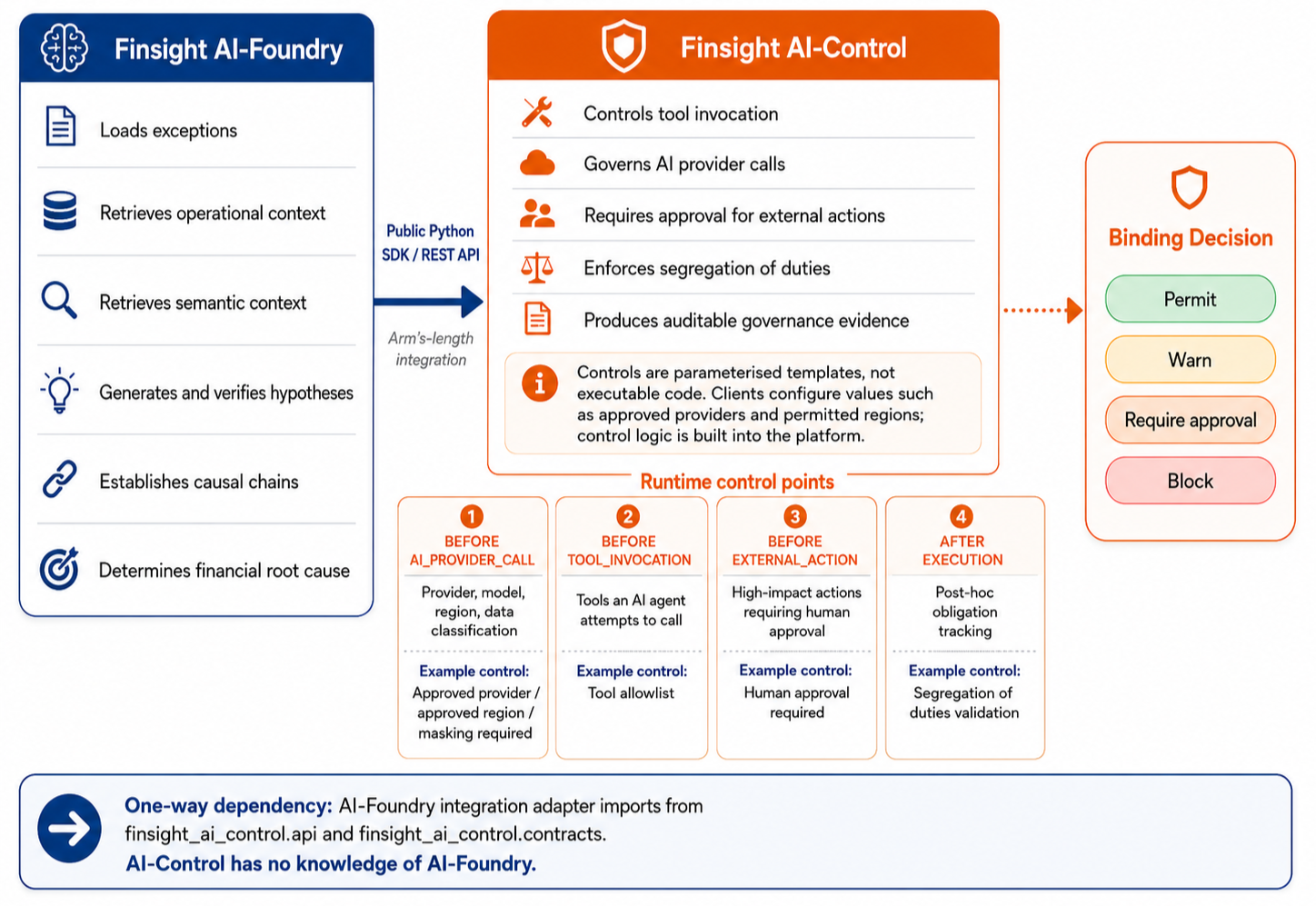
Architecture
Three layers — Application, Runtime, and Governance Foundation — connected by public APIs and bindings.
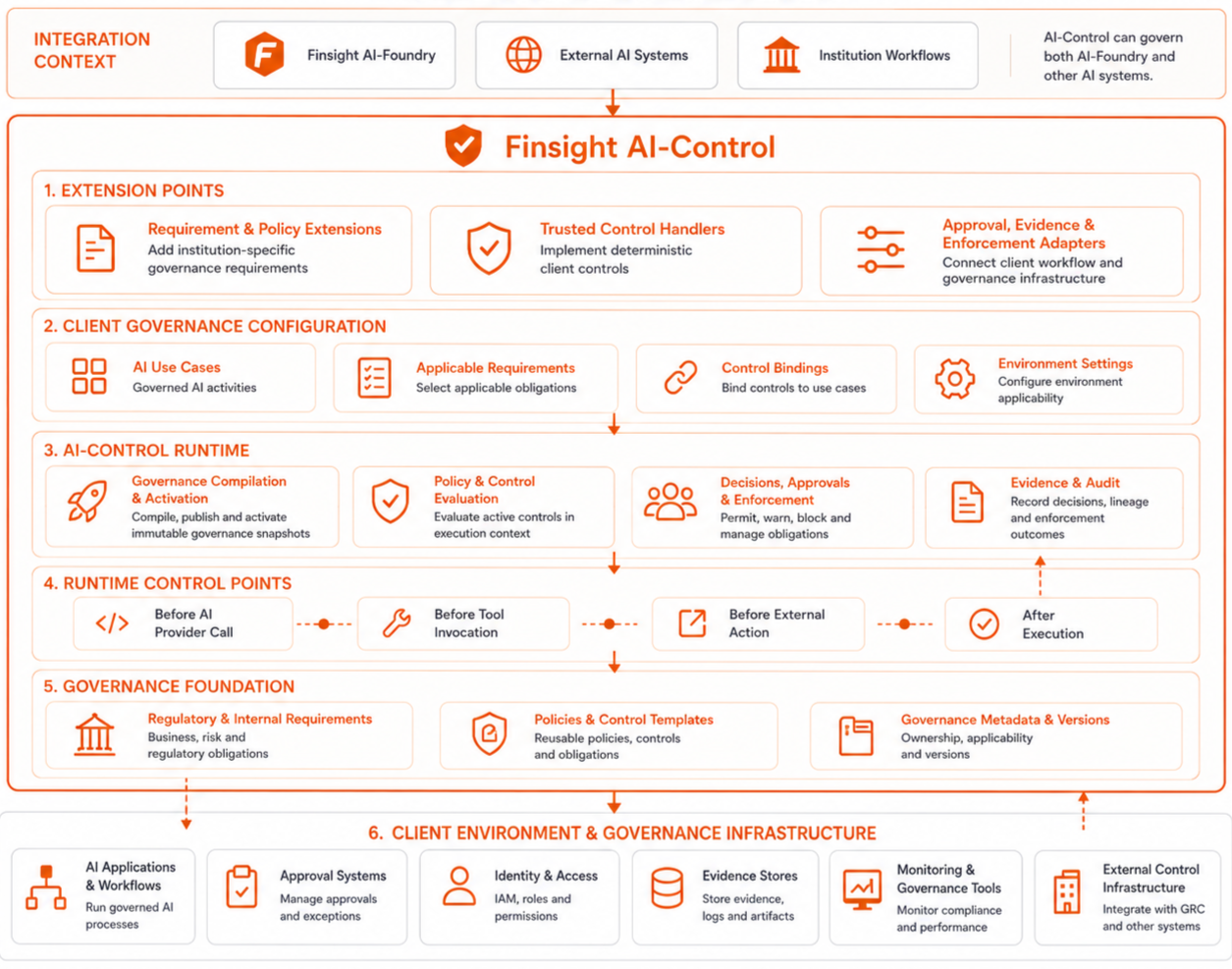
Key Architectural Decisions
Six architecture decision records that define AI-Control's design constraints.
No Policy Layer
Controls execute directly. There is no Policy DSL, no REGO, no CEL, no visual rule builder. Control templates are parameterised; the platform owns the execution logic.
Immutable Snapshots
One evaluation = one governance snapshot. Configuration changes create new snapshots — they never affect in-flight evaluations. Every snapshot has a SHA-256 fingerprint.
Customer-Owned Evidence
AI-Control builds evidence records. The customer stores them via an EvidenceSink protocol — their Splunk, their Elastic, their object storage. No hosted multi-tenant evidence platform.
Three-Dimensional Decisions
Not a flat ALLOW/DENY. Every decision carries: outcome + approval requirements + obligations. A DENY with obligations says "blocked for now, but here's what must change."
Fail-Closed
Any governance error — unavailable configuration, broken snapshot, unreachable evidence sink — blocks the operation. Default is safety.
Zero Dependency on AI-Foundry
AI-Control is an independent product. Architecture tests verify zero imports from AI-Foundry across all 64 platform files.
Governance Foundation
Governance configuration is compiled into an immutable, fingerprinted snapshot before activation — one evaluation, one governance state.
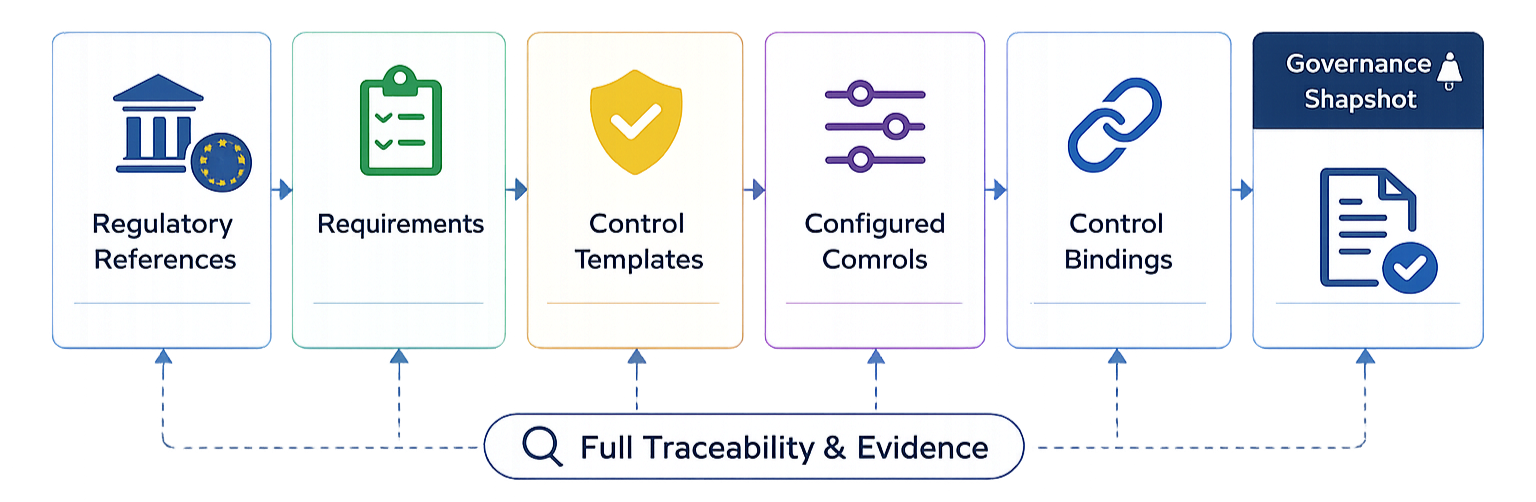
The chain is explicit: a regulatory reference points to a requirement like "high-impact AI actions require human oversight." That requirement selects controls like "human approval required" and "segregation of duties." Those controls are bound to specific control points. When the snapshot is activated, the runtime evaluates controls against that active snapshot — and the evidence record captures every link in the decision chain.