Why Financial AI Needs a Foundry
Modern AI frameworks make it easy to call models and coordinate tools. But they don't provide the foundations required for governed financial AI.
Data Is Disconnected from Meaning
Financial data sits in siloed schemas, proprietary formats and undocumented pipelines. Schemas describe how data is stored, not what it means. Business context, financial concepts and rules are lost between systems.
AI Lacks Financial Understanding
Generic AI models do not understand financial concepts, instruments, lifecycle events or regulatory context. They can produce convincing outputs that are incomplete, irrelevant or wrong without governed access to financial meaning and operational state.
Evidence Is Untraceable
Financial institutions need more than an answer. Every output must carry an evidence path — the source data, lineage, transformations and rules behind it — so results can be traced, audited and shown to be fit for purpose.
Governed financial meaning + operational state + evidence + AI execution + resource access + bounded capabilities = governed financial AI applications.
AI-Foundry Architecture
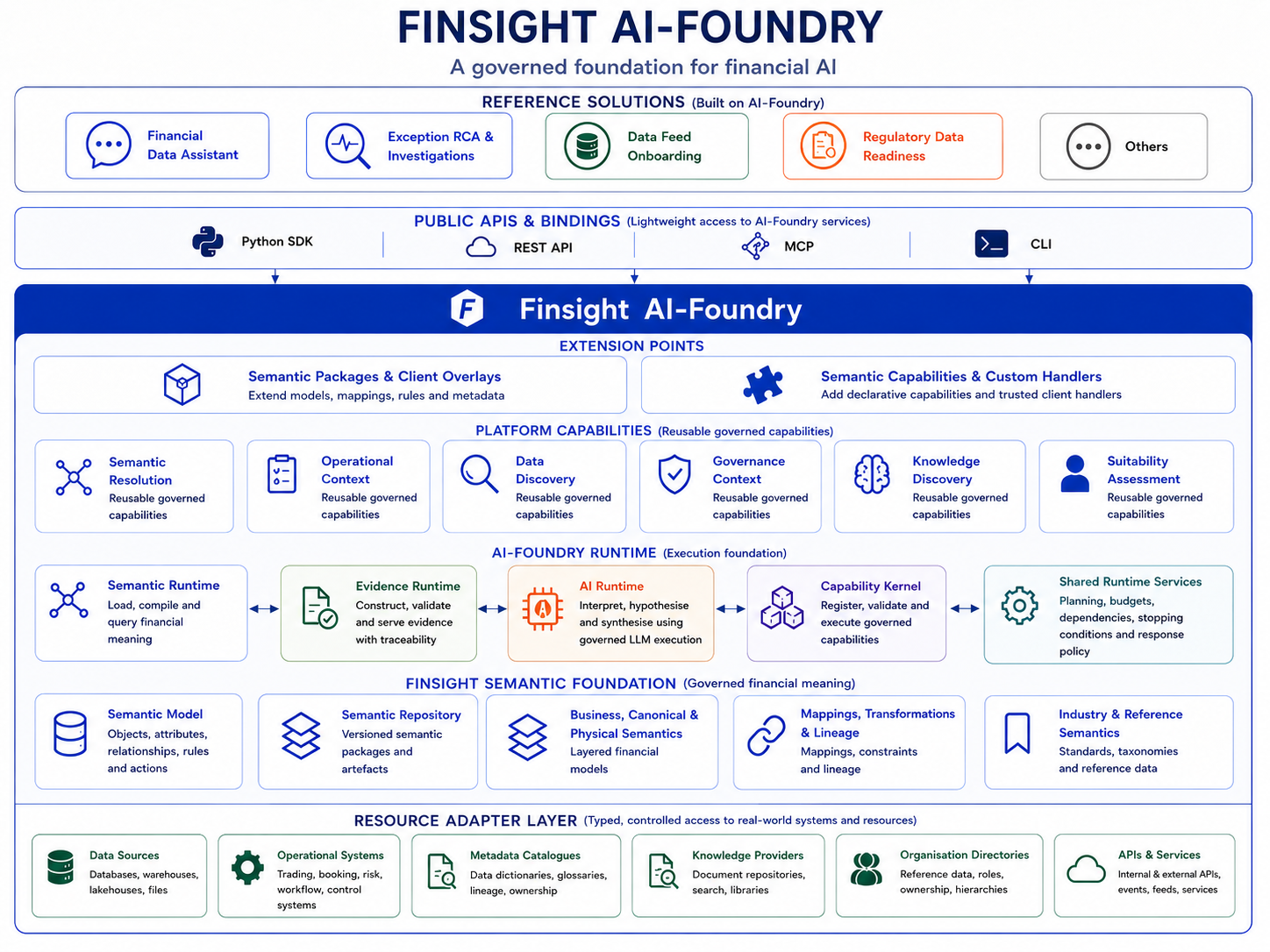
AI Runtime, shared runtime services, platform capabilities, resource adapters, extension points, APIs and reference solutions — built on the Finsight Semantic Foundation.
Finsight Semantic Foundation
The shared underpinning. Declarative, extensible, reusable — organised financial meaning on which AI-Foundry depends.
Industry-Aligned Foundation
Starts from established financial concepts, modelling patterns and industry standards — the ISDA Common Domain Model, the Financial Industry Business Ontology, regulatory data models, and common product and lifecycle concepts.
Finsight Semantic Repository
Reusable semantic structures: metamodels, financial ontologies, canonical concepts, relationship definitions, mapping structures, rules, control patterns, evidence relationships and reference artefacts — so institutions do not design every structure from scratch.
Institution Semantic Repository
Each institution extends the common foundation with its own business terminology, product and process models, systems, schemas, confirmed mappings, transformation rules, lineage, ownership, policies and operational knowledge.
The Semantic Foundation defines and stores governed financial meaning. AI-Foundry loads, compiles, queries and uses that meaning during execution. The separation keeps financial semantics portable, versioned and independently governed — while runtime implementations can evolve without redefining the underlying meaning.
AI-Foundry Runtime
Five runtime components with clear responsibilities — not a single large orchestration engine.
Semantic Runtime
Turns repository definitions into stable, queryable financial context — Load, Resolve, Validate, Compile, Snapshot, Publish, Activate, Query.
Evidence Runtime
Constructs and manages traceable evidence used during execution — source identity, provenance, observation time, derivation, and integrity.
AI Runtime
Performs model-mediated interpretation, hypothesis generation and synthesis — the AI-execution layer that reasons over governed financial context using governed LLM execution to produce structured, evidence-backed outcomes.
Capability Kernel
Registers, discovers and executes governed capabilities. Consumers invoke stable typed contracts — they don't call internal runtime components directly.
Shared Runtime Services
Cross-cutting execution concerns: planning, workflow-level budgets, dependencies, stopping conditions, response policy, diagnostics, telemetry, and failure handling.
Semantic Runtime lifecycle:
The Semantic Repository remains declarative. The Semantic Runtime is responsible for processing those definitions into stable, queryable snapshots — capabilities execute against that stable state rather than reading evolving source files directly.
Platform Capabilities
Six capability groups that institutions compose into their AI-native data foundation.
Semantic Resolution
Resolve concepts, retrieve definitions, traverse relationships, trace mappings, inspect lineage, identify applicable rules, and assess semantic impact.
Data Discovery
Locate and inspect relevant data assets — datasets, tables, fields, reports, APIs, ownership, lineage, quality indicators, and platform location.
Operational Context
Retrieve time-bound information from trading systems, data platforms, risk engines, workflow systems, control platforms, and client APIs.
Governance Context
Understand which policies, controls, ownership structures or restrictions apply to a capability or data asset — without placing governance logic inside every workflow.
Knowledge Discovery
Retrieve relevant information from documentation, procedures, specifications, previous investigations, regulatory material, and internal knowledge bases.
Suitability Assessment
Assess whether available data is appropriate for a calculation, investigation, regulatory report, model input, reconciliation, or operational decision.
Resource Adapter Layer
Typed, controlled access to real-world systems and resources — each adapter provides a stable contract so AI workflows never call raw APIs directly.
Operational Systems
Typed adapters for trading, booking, risk and workflow control systems — each adapter enforces a schema contract so AI workflows interact with real systems through governed, predictable channels.
Data Sources & Catalogues
Connectors for databases, warehouses, lakehouses, data dictionaries, glossaries and lineage platforms — providing typed access to data assets without exposing raw connection details.
Knowledge & Organisation
Adapters for document repositories, search platforms, reference data stores, organisation directories and internal APIs — translating platform contracts into system-specific operations.
Resource adapters provide the typed access layer between AI-Foundry capabilities and real financial systems. They translate platform contracts into system-specific operations — the client remains responsible for adapter correctness, security and lifecycle.
Extension Points
Financial institutions have different products, systems, policies, and operating processes. AI-Foundry provides controlled extension without requiring clients to fork the core.
Semantic Packages & Client Overlays
Extend reusable financial meaning with institution-specific applications, schemas, fields, mappings, rules, ownership, controls, and local terminology. Overlays extend without copying the shared foundation.
Capabilities & Custom Handlers
Add new capabilities through stable typed contracts. Custom handlers can use proprietary APIs, internal calculation services, Neo4j, NetworkX, databases, workflow systems, or specialist libraries.
Integration Ports & Adapters
Register custom adapters for proprietary systems, specialist platforms and internal infrastructure — extending the Resource Adapter Layer through the same stable adapter contracts for systems not covered by platform-provided adapters.
Public APIs & Bindings
AI-Foundry is accessed through open, well-defined interfaces — not a closed user application.
Other AI agents can use AI-Foundry to resolve financial concepts, discover institutional data, retrieve graph-grounded context, trace lineage, obtain approved evidence and invoke governed workflows — reusing one financial semantic foundation across many AI applications.
Reference Solutions
Thin demonstration applications that show how AI-Foundry can be applied to real financial-services problems — without turning each use case into a separate platform.
A reference solution contributes a defined business problem, solution-specific workflows, capability composition, configuration, and presentation. It does not duplicate semantic compilation, evidence management, capability execution or governance logic. Those responsibilities belong to the product core.
Working with Real Financial Systems
AI-Foundry connects to existing infrastructure — it does not replace it.
Financial data and operational state continue to reside in trading and booking platforms, warehouses and lakehouses, risk and valuation systems, workflow and control platforms, document repositories, client APIs, model platforms, and observability systems.
AI-Foundry connects to these environments through the Resource Adapter Layer — typed, governed adapters that provide stable contracts to real systems. Custom handlers extend this layer for proprietary platforms. The client remains responsible for the correctness, security and lifecycle of custom extensions.
Governed by AI-Control
AI-Foundry provides the governed foundation. AI-Control provides the independent governance and runtime-control layer.
AI-Foundry and AI-Control have complementary but separate responsibilities. AI-Foundry answers "what financial capability should be invoked, what context does it require, and what evidence supports its result?" AI-Control answers "is this use case permitted to perform the proposed operation, which controls apply, and how is that decision evidenced?"
Safety is first-class
Governance and runtime assurance are architectural capabilities — not controls added after implementation. Explore Finsight AI-Control →