From financial situation to explainable analysis
Each example shows what the analysis takes in, how it connects the information, and the explainable output that results. Outputs are inputs to professional judgement, not recommendations.
The underlying financial context models can support:
- Investment and reinvestment needs
- Portfolio and position analysis
- Exposure and hedging analysis
- Liquidity and cash-flow assessment
- Financial market-event interpretation
Sales and relationship-management use cases remain valid commercial applications of the same models.
Bond maturity and reinvestment
Inputs
- Instrument terms and maturity schedule
- Portfolio holdings
- Investment constraints and mandate
- Current market conditions
Transformations
- Derive contractual cash flows from instrument terms
- Aggregate expected cash by date and portfolio
- Test deployable cash against constraints and liquidity needs
Outputs
- Expected liquidity and reinvestment horizon
- Upcoming investment decisions
- Relevant market considerations
FX exposure and hedging
Inputs
- Positions and underlying currency flows
- Existing hedges and hedging policy
- FX market moves
Transformations
- Aggregate net exposure by currency
- Compare exposure with existing hedges and policy limits
- Run scenarios on currency moves
Outputs
- Unhedged exposure and its sensitivity
- Scenario impact on the portfolio
- Exposure situations requiring review
Market event impact
Inputs
- The market event and the instruments it affects
- Portfolio positions and exposures
- Mandates and constraints
Transformations
- Map the event to affected instruments
- Trace affected instruments to portfolios and exposures
- Quantify the exposure affected
Outputs
- Exposures affected by the event
- Scale of the potential impact
- Portfolios requiring review
Liquidity and funding
Inputs
- Cash balances and funding positions
- Upcoming maturities and cash flows
- Collateral requirements
Transformations
- Project cash and funding positions over time
- Combine liquidity and funding signals into one view
- Compare the projection with buffers and constraints
Outputs
- Projected liquidity position
- Funding gap or deployable surplus
- Situations requiring liquidity analysis
Example: Bond Maturity and Reinvestment
- Identify a portfolio bond approaching maturity.
- Interpret contractual maturity and cash-flow information.
- Determine the potential change in portfolio cash availability.
- Connect this information to the portfolio's relevant financial context.
- Identify a situation that may require reinvestment analysis.
- Present an explainable research finding to support further professional assessment.
Illustrative flow using synthetic data. Read the worked example →
Research status
Client Investment Intelligence is an R&D application. The analytical examples on this page use synthetic or illustrative data to show the intended approach. They are designed to support professional analysis and do not describe production deployments, investment performance or personalised recommendations.
Understand what matters to the client now
A bond approaching maturity is not, by itself, an opportunity.
A changing FX exposure is not, by itself, an opportunity.
A market event is not, by itself, an opportunity.
Commercial opportunity emerges when those signals are understood in the context of the client — their portfolios, exposures, mandates, liquidity needs, existing activity and the institution's ability to respond.
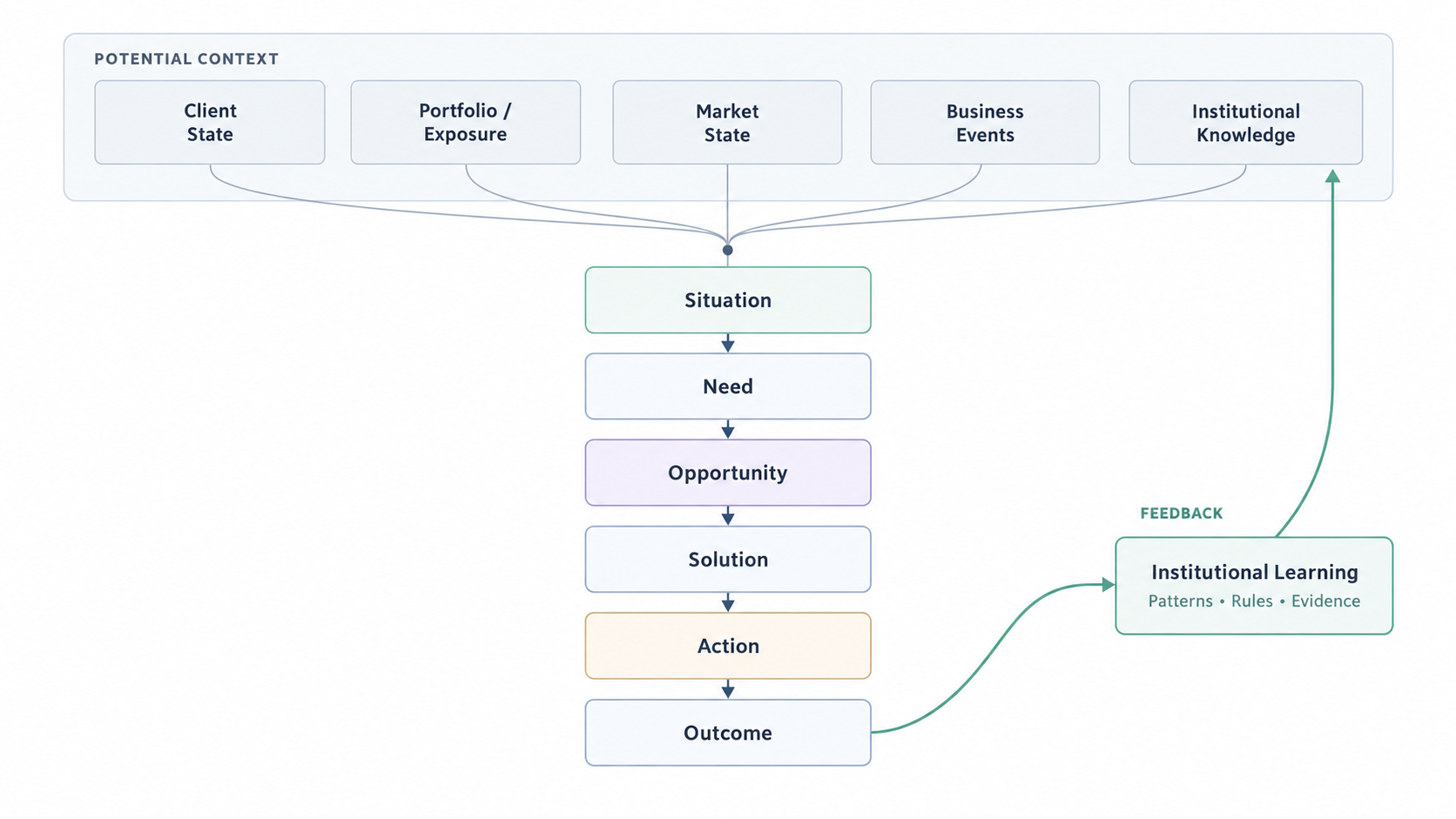
Changing client and market state becomes meaningful only when interpreted through client context, need and institutional capability.
From signals to actionable opportunities
Finsight treats opportunities as evidence-supported business situations rather than generic AI recommendations or product propensity scores.
The intelligence process connects:
Each opportunity can retain the evidence and reasoning that explains:
- what changed;
- why it matters to the client;
- what client need may exist;
- why the institution can respond;
- how long the opportunity remains relevant;
- and what action follows.
This allows AI to operate on explicit financial context rather than reconstructing the institution's business meaning from scratch.
One intelligence model. Multiple scenarios.
Beyond investment analysis, the same model supports commercial client-coverage, relationship-management and financing use cases, organised around the client's economic need rather than the bank's internal product silos.
Investment & Reinvestment
Identify situations where maturing assets, incoming cash or portfolio changes may create a need to deploy or reallocate capital.
Examples:
Risk Management
Recognise when changing exposures may create a need to review or adjust the client’s risk position.
Examples:
Financing
Identify current or anticipated funding needs across the client’s financing structure.
Examples:
Liquidity
Understand where changing cash, collateral or funding conditions may create liquidity needs.
Examples:
Market Events
Connect external market events to the clients, positions and exposures they actually affect.
Examples:
Relationship Opportunities
Identify relevant institutional capabilities where an evidenced client need is not currently being served.
Examples:
Opportunity patterns turn institutional knowledge into repeatable intelligence
Finsight models how commercially meaningful situations arise.
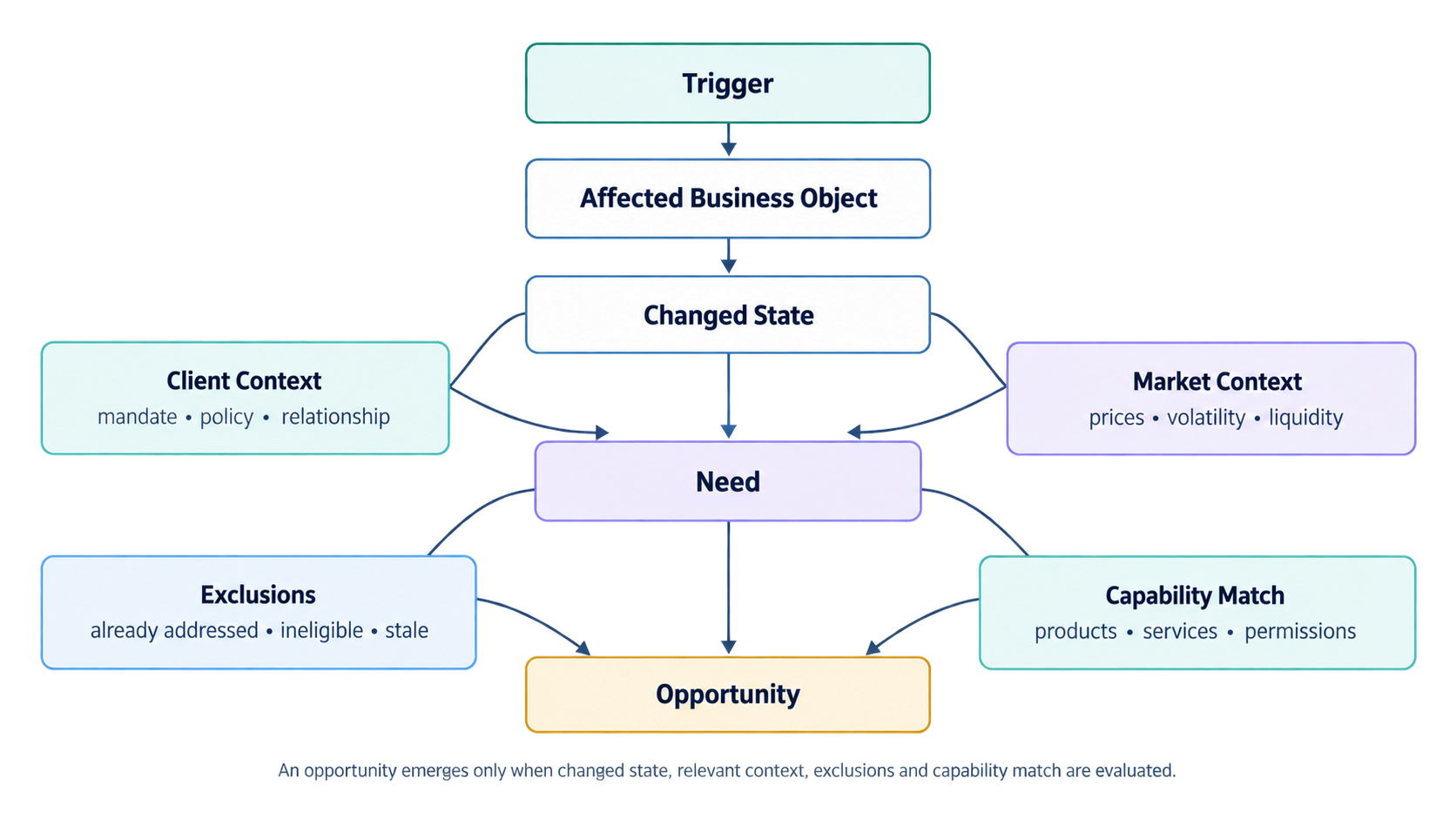
Intelligence built on connected financial context
Client Investment Intelligence requires more than CRM data or a product recommendation model.
Finsight connects the parts of the institutional world that determine whether a situation actually matters:
The result is a financial context layer that can support rules, analytics, AI and human judgement using a shared representation of the client world.
Works with your existing data and technology
Client Investment Intelligence can operate across existing institutional systems and platforms.
Sources may include
Palantir Foundry & AIP
Use operational ontology objects, links, functions and actions to discover and act on opportunities inside Foundry.
Open Semantic Stack
Use open standards such as RDF, OWL and SPARQL to build a portable financial semantic and opportunity intelligence layer.
The business model remains consistent across implementation approaches.
From client data to client understanding
The objective is not to generate more leads. It is to continuously understand: