Why financial AI needs context
Financial data alone does not fully represent the business knowledge needed to interpret it. Financial meaning depends on:
- Financial instruments and economic structures
- Business concepts and relationships
- Institutional rules and practices
- Portfolios, positions and exposures
- Events and business processes
- Decision logic and analytical context
The Financial Context Layer helps AI access and use this knowledge rather than relying exclusively on raw data, documents or language-model inference.
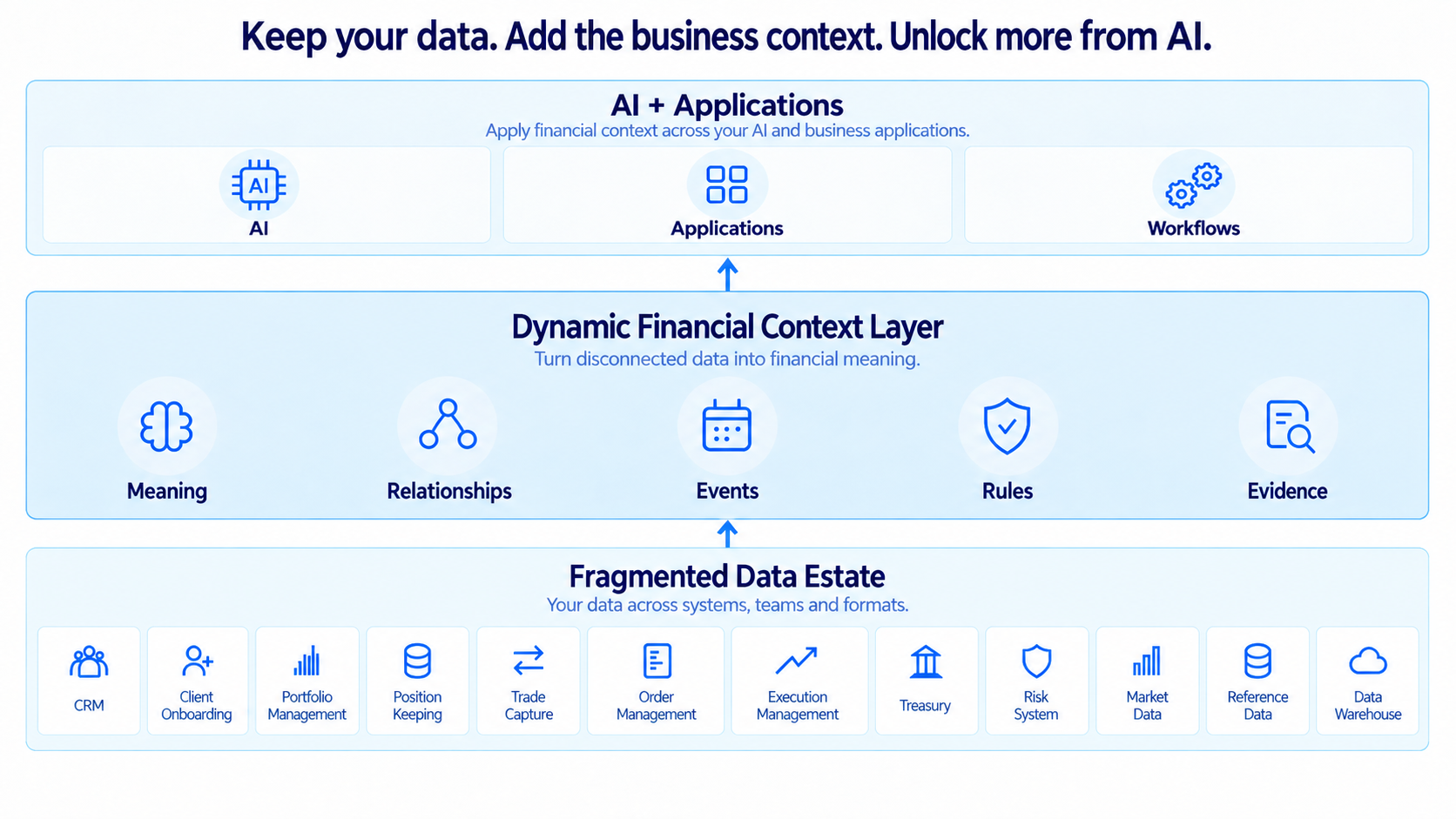
What the Financial Context Layer provides
Financial Knowledge Modelling
Build financial ontologies and semantic layers that capture and represent institutional business knowledge in a structured, machine-interpretable form.
We model financial and investment knowledge, including financial instruments, portfolios, positions, risk exposures, investment strategies, business relationships, institutional rules and decision logic.
Our approach combines ontology modelling, knowledge graphs and semantic technologies to connect this knowledge with underlying enterprise data and applications.
Industry models such as FINOS CDM and FIBO can provide reference concepts where appropriate, while institution-specific knowledge captures the business meaning, rules and practices unique to each organisation.
This enables AI applications to interpret financial information in its business context and support investment analysis, risk assessment and explainable decision-making.
Connected Financial Context
Connect financial concepts, business relationships, rules and events to the institution's existing data, systems and applications. Enable AI to interpret information in the context of the organisation's financial activities and business processes.
Evidence & Traceability
Connect AI-accessible financial knowledge and analytical outputs to their underlying data sources, mappings, business rules and evidence. Support explainability, governance, auditability and investigation of AI-generated results.
AI-Ready Financial Knowledge
Expose structured financial knowledge through reusable models, APIs, query interfaces and governed capabilities for AI applications and agents.
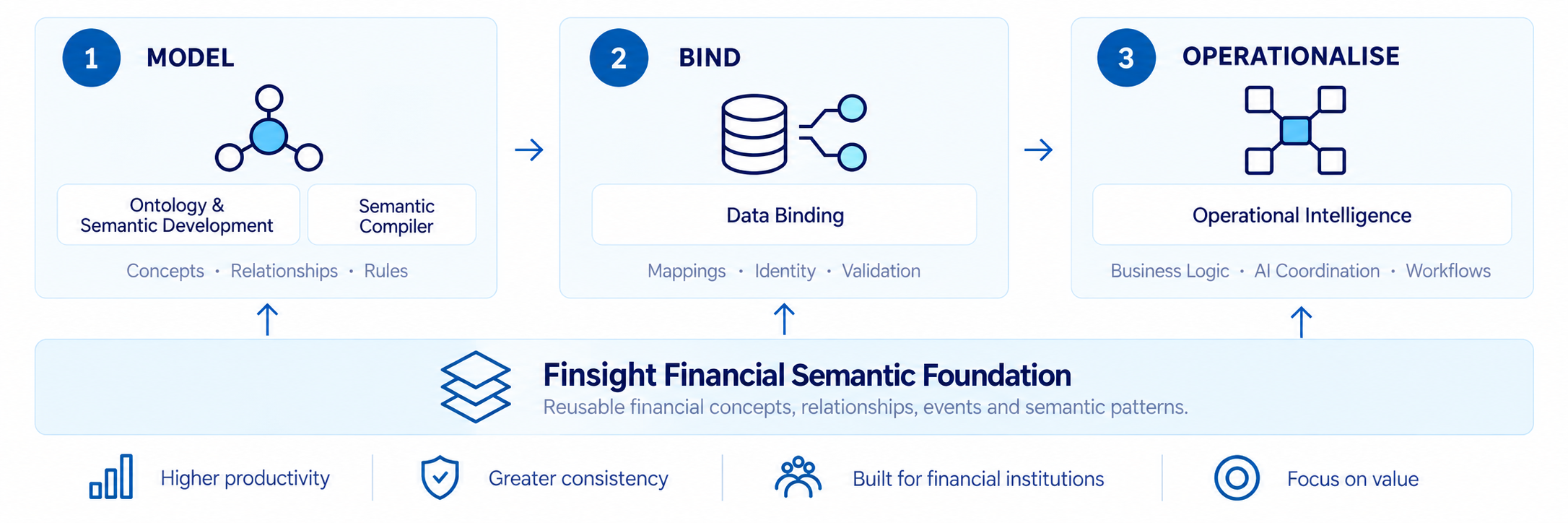
Model → Bind → Operationalise
1. Model
Capture financial concepts, relationships, rules, constraints and institutional knowledge through ontologies and semantic models.
2. Bind
Connect those models to existing business data, applications and operational systems.
3. Operationalise
Make financial knowledge and context available to analytical systems, AI applications and agents through reusable software capabilities.
The Financial Context Layer complements existing financial technology infrastructure. It does not replace it.
Finsight AI-Foundry
AI-Foundry is the engineering framework for implementing and operationalising Financial Context Layer capabilities.
Financial Context Layer
The business knowledge and context architecture.
AI-Foundry
The reusable software and implementation framework that enables this architecture to be developed and used.
Designed to support financial applications
Investment & Portfolio Intelligence
Enable applications to interpret portfolio holdings, financial instruments, exposures and cash flows for investment-related analysis.
Financial Risk & Liquidity
Connect positions, contractual obligations and market events to support financial risk interpretation, hedging and liquidity analysis.
Financial Product & Trade Intelligence
Support interpretation of product structures, economic terms, trade events and lifecycle information.
Regulatory & Operational Intelligence
Support AI-assisted interpretation, analysis and automation in complex financial and regulatory workflows.
Built on open semantic technologies
Relevant financial domain models can serve as reference concepts where appropriate. FINOS CDM and FIBO are optional reference models and are not required for every implementation.